EV / Exosome Consultation

Before the name, look at the source and records.

EV stands for extracellular vesicle: a broad scientific term for small particles released by cells. “Exosome” is widely used, but it does not always describe the whole product precisely. Before deciding, patients should understand source, donor assumptions, lot records, contamination-control checks, release records, storage, transport, and physician explanation.

Why EV, Not Only Exosome

EV is the wider umbrella.

EV includes a broader range of extracellular vesicles. A product called “exosome” may still require characterization: source cell, donor route, collection method, purification, particle count, protein information, sterility-related checks, and storage records.

What this page does

It helps you organize questions before physician consultation. It does not claim that an EV-related option will work for a particular condition, replace standard care, or remove risk.

Patient Visual Guide

Donor source and quality records are easier to understand visually.

EV source, donor, purification, and quality-record review diagram
The diagram shows review items: multiple-donor or unknown-source routes, personal / traceable-source routes, collection and purification, particle count, size distribution, sterility, endotoxin, mycoplasma, residual cells or fragments, storage, and transport. These are review items, not proof of clinical effect.
Source

Multiple donors or traceable source

If several donors or unclear source materials are involved, product consistency and explanation become harder. Personal iPS-derived routes are discussed separately as patient-derived and traceable-source routes.

Contamination

What contamination means

Contamination means unwanted microorganisms, components, residual cells, cell fragments, or other material mixing in. Documents should show how this is controlled and checked before release.

Release

Documents to ask for

Lot number, release date, handling window, sterility, endotoxin, mycoplasma, particle / protein information where supplied, storage, and transport records.

Responsibility

Manufacturer and clinic roles

The supplier is responsible for product-quality records. The clinic is responsible for medical review, explanation, individual judgment, follow-up, and adverse-event communication.

Personal iPS-Derived EV

A separate route with its own timeline.

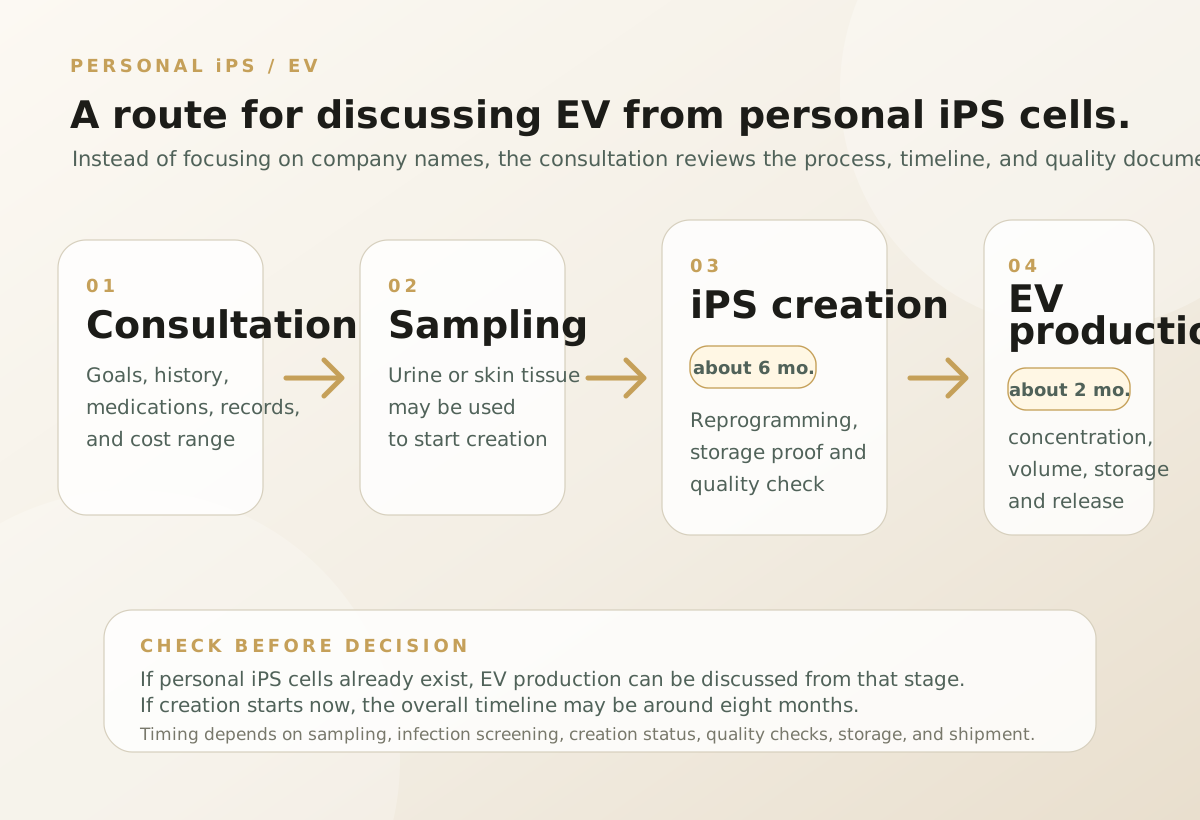
Personal iPS-derived EV is explained as a patient-derived route. Creating personal iPS cells may take about six months, and EV manufacturing may take about two additional months. Actual feasibility, timing, required documents, cost, and release records are confirmed individually.

Personal iPS and iPS-derived EV process flow

EV / exosome-related services are discussed only through physician consultation with records. The discussion includes what is known, what is still unknown, unapproved-use boundaries where relevant, alternatives, risks, cost, and consent materials.